
Partnerships
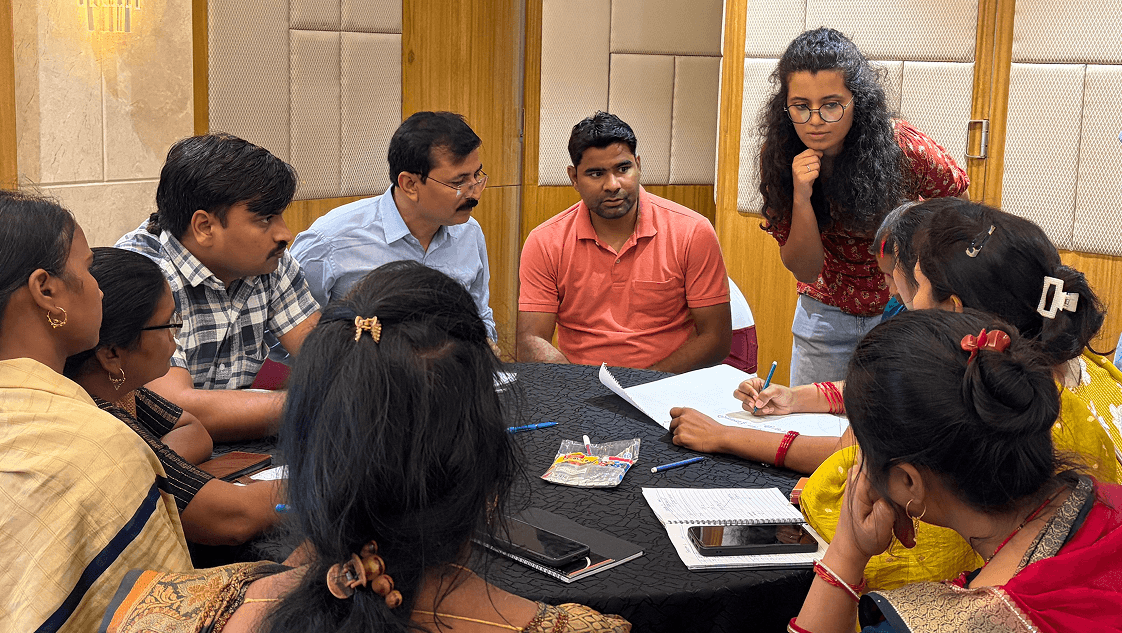
We partner with organisations across diverse geographies and sectors to extend mental health and social care beyond our direct implementation sites. Since mental wellbeing is shaped by factors such as education, health, employment, gender, and livelihoods, we collaborate across sectors to address mental health through a psychosocial lens.
Hear from our partners
Pearl Tiwari
CEO, Ambuja Foundation

Dr. Vinayak Sonawane
Associate Director, Ambuja Foundation

Our partnerships begin with value alignment
Strong partnerships emerge from shared values. We collaborate with organisations that view communities as leaders and problem-solvers: centering lived experience, participatory action, and locally led change.
We believe that through capacity building and training, communities can tap into their inherent social capital to support one another, and that lived experience positions them best to understand and respond to their own mental wellbeing. Centering communities is key to creating sustainable mental health and social care.
We work with partners to co-create, co-design, and adapt Atmiyata for the local context. Our focus is on building long-term capacity so that communities and partners can lead and sustain the work, while we provide ongoing technical support. With experience in scaling the model with diverse partners and government systems, we bring institutional capacity required for expanding.
We have established structured systems, processes, and leadership to support partnerships at scale. Throughout this process, we are continuously reflecting, measuring, and adapting to fit Atmiyata within the community context.
Our partnership process

Scope
- Value Alignment
- Approach to Work
- Ecosystem Mapping

Adapt
- Project Planning
- Co-design of the Intervention

Build
- Capacity Building
- Technical Support for Implementation

Impact
- Monitoring & Evaluation
- Scale Up
Scope
We work closely with organisations, institutions, and community-based groups to explore how the Atmiyata model can be adapted and embedded within diverse contexts and geographies. Our partnership process begins with a conversation which is an opportunity to understand each other’s work, values, commitments, and vision for collaboration. At the heart of this process is a strong focus on alignment: we seek partnerships rooted in community participation, collaboration, and long-term commitment to mental health and wellbeing.
As part of this journey, we often undertake a scoping visit to better understand the local ecosystem, existing structures, and community dynamics. These visits allow us to interact with programme teams, stakeholders, and community members to assess how Atmiyata can meaningfully integrate into ongoing initiatives. Since the model is volunteer-driven and community-led, we especially value partnerships that recognise and support collective ownership and grassroots leadership.
Our approach is relational, reflective, and adaptive. We believe meaningful scale is built through trust, shared learning, and a deep understanding of context which helps us expand mental health support in ways that are locally relevant and sustainable.
Adapt
The next step of the journey is to reach an agreement for adopting Atmiyata. This step focuses on co-design and aims to adapt the intervention to the local realities of the communities.
Project Planning
Once a partnership is established, we work collaboratively with partners to develop a clear implementation roadmap tailored to their context and goals. This includes creating a partnership agreement that define roles, responsibilities, implementation structures, and shared outcomes. Together, we identify expected impact goals, implementation milestones, and the support required for successful rollout. Throughout this process, we aim to build a strong foundation for sustainable and community-led implementation.
Co-Design & Adaptation
Atmiyata’s approach is rooted in co-design and contextual adaptation. We work closely with partners and community members to collectively imagine what a community mental health intervention could look like within their specific setting. Through consultations and participatory discussions, we identify key stressors, existing gaps in support systems, local stakeholders, and opportunities to integrate mental health into ongoing community programmes and structures.
The adaptation process is gradual and collaborative, often spanning several months of consultation, planning, and community engagement before training begins. Our long-term goal is to support partners in building ownership of the intervention within their own ecosystems, enabling sustainable and locally driven implementation over time.
Build
Capacity Building
Capacity building is a core part of the process, focused on equipping communities with the knowledge, skills, and confidence to deliver community mental health support within their own contexts. Our training approach is deeply participatory that helps ensure that the training is relevant, culturally responsive, and rooted in the lived experiences of participants. While the technical knowledge and intervention framework remain consistent, significant emphasis is placed on strengthening facilitation skills, community engagement practices, reflective listening, and the ability to navigate conversations with empathy and care.
Technical Support & Quality Assurance
Our capacity building is also coupled with providing technical support to help partners successfully operationalise and sustain the intervention. During this phase, partners often undertake activities such as identifying community champions, mapping villages and communities, and strengthening implementation systems within their local context.
The Atmiyata team provides continuous guidance throughout this process through regular communication, troubleshooting support, and quality assurance visits. These visits allow our team to observe trainings, provide feedback on facilitation and implementation quality, and support partners in adapting the model effectively while maintaining the integrity of the intervention. Our role throughout implementation is to act as a technical and strategic support partner — helping organisations build confidence, strengthen systems, and gradually take ownership of the intervention within their own ecosystems.
Impact
Monitoring & Evaluation
Atmiyata’s implementation approach is rooted in continuous learning, evidence generation, and long-term community impact. Once community champions begin delivering support within their communities, we work closely with partners to monitor implementation progress, strengthen quality, and understand the effectiveness of the intervention over time to ensure the implementation remains community-driven, contextually responsive, and aligned with the core principles of Atmiyata.
Depending on the geography, partner, and implementation model, evaluation approaches may differ and can include interim assessments at different stages of implementation. Regular review and troubleshooting meetings — including monthly implementation check-ins and quarterly reflection sessions — help identify challenges early, strengthen implementation quality, and encourage adaptive learning throughout the programme lifecycle.
Scale-Up & Sustainability
Our long-term vision is to support sustainable, locally owned community mental health ecosystems that can continue beyond the initial implementation period. Over time, partners increasingly adapt, strengthen, and expand the intervention within their own systems and geographies. Through continuous capacity building, structured implementation support, and iterative learning, scale-up is approached thoughtfully and relationally, with a focus on strengthening existing community structures, developing local leadership, and embedding mental health support into broader development ecosystems. As partnerships mature, communities and implementation teams often begin identifying new opportunities, innovations, and pathways for expansion — helping the intervention evolve organically while remaining grounded in the principles of community participation, care, and collective ownership.